- Nootropic Blend Team
- Published May 19, 2026
- Affiliate disclosure
We prioritize readers, not ads. Editorial independence. Free, factual information. A small fee from product links, no extra cost to you.
Most people today don’t actually need more stimulation.
They need better recovery from chronic stimulation.
That’s part of what makes many of the reported Rhodiola rosea benefits so interesting today.
Unlike aggressive stimulants that push the nervous system harder, Rhodiola is traditionally used as an adaptogen — a compound associated with stress resilience, steadier energy, and mental endurance under pressure.
And the difference is often noticeable.
Instead of the sharp “push” people associate with caffeine-heavy productivity supplements, Rhodiola tends to feel smoother and more balanced.
Less friction. Less mental drag.
For some people, the effect isn’t even “energy” in the traditional sense.
Work simply feels more manageable.
As we explore throughout our guide to natural nootropics, cognitive performance is often less about forcing more output — and more about helping the nervous system stay within an optimal range.
Rhodiola rosea is a stress-support adaptogen associated with calmer energy, mental endurance, and smoother focus under pressure.
Unlike aggressive stimulants, Rhodiola tends to support resilience and recovery rather than forcing intensity.
The best Rhodiola supplements usually prioritize sourcing quality, phytochemical balance, and full-spectrum extraction over inflated potency claims.
Table of Contents
What Makes Rhodiola Different?
Rhodiola rosea is not a classic stimulant.
That distinction matters more than most supplement marketing suggests.
Many people struggling with “low energy” are not actually under-stimulated. They’re overloaded.
Poor recovery. Chronic stress. Fragmented focus. Nervous system fatigue.
Adding more stimulation on top of that can work temporarily.
But eventually, the system pushes back.
This is where adaptogens become interesting.
Rather than forcing intensity, Rhodiola is traditionally used to support how the body responds to stress itself.
That’s a very different mechanism — and usually a very different experience.
This idea closely mirrors what we describe in the U-Curve model of nootropics, where more stimulation does not always translate into better cognitive performance.
In practice, many people describe Rhodiola less like a caffeine rush — and more like reduced mental friction.
Work feels smoother. Stress feels less “sticky.”
And unlike many productivity-focused nootropics, Rhodiola often feels most effective when used consistently and moderately rather than aggressively.
That balance becomes especially important when choosing the right extract.
What Does Rhodiola Actually Feel Like?

One reason Rhodiola rosea has remained popular for decades is that its effects often feel surprisingly different from traditional stimulants.
For many people, the experience is less about intensity — and more about reduced internal resistance.
Tasks feel easier to start. Mental fatigue feels less emotionally heavy. Long work sessions become more sustainable.
Not sharper in a frantic way. Just steadier.
This is also why Rhodiola can feel confusing at first.
Some people expect a dramatic “kick” similar to caffeine or strong pre-workout formulas. Instead, the effects are often subtle and cumulative — especially at moderate doses.
In practice, the biggest difference is often stress tolerance.
You may notice:
- smoother focus under pressure
- less cognitive exhaustion after demanding work
- reduced feeling of mental overload
- steadier energy across the day
- better resilience during stressful periods
At the same time, response can vary heavily depending on the extract itself.
Some standardized formulas feel clean and activating. Others feel flat, overstimulating, or emotionally “dry.”
This is one reason sourcing and extraction methods matter far more than most labels suggest.
| Rhodiola Often Feels Like | Caffeine Often Feels Like |
|---|---|
| Smooth mental endurance | Sharp stimulation |
| Steadier energy | Fast energy spike |
| Lower mental friction | Increased urgency |
| Stress resilience support | Performance push |
| Gradual, cumulative effects | Immediate noticeable effects |
This distinction becomes even clearer when Rhodiola is compared directly to caffeine-heavy energy supplements.
Rhodiola vs Caffeine
Caffeine increases stimulation.
Rhodiola rosea tends to support resilience.
That’s not a perfect comparison — but it captures the difference surprisingly well.
Caffeine often creates a sharper sense of urgency and alertness. Rhodiola usually feels steadier and less aggressive.
Less “push harder.” More “handle pressure better.”
Many people today are not dealing with a lack of stimulation — but with an inability to recover from constant stimulation.
For some people, that distinction becomes more noticeable over time.
Instead of chasing short bursts of intensity, Rhodiola is often used to support:
- smoother mental endurance
- steadier focus under stress
- reduced cognitive fatigue
- calmer productivity across the day
At the same time, response varies heavily depending on the extract itself.
Some formulas feel clean and balancing. Others feel overstimulating, flat, or emotionally “dry.”
That’s one reason quality matters far more than most labels suggest.
Why Quality Matters More Than Label Claims
Two Rhodiola rosea supplements can look nearly identical on paper — yet feel completely different in practice.
That’s because Rhodiola’s effects depend on far more than a few standardized compounds like rosavins and salidroside.
Extraction methods, sourcing quality, and phytochemical balance all influence how an extract actually feels.
Potency doesn’t always equal quality.
Some formulas feel smooth and balancing. Others feel overstimulating, flat, or inconsistent over time.
With Rhodiola especially, balance often matters more than sheer intensity.
Standardized Extracts vs Full-Spectrum Root
Most modern Rhodiola rosea supplements use standardized extracts.
These formulas are adjusted to fixed levels of rosavins and salidroside in order to create more predictable dosing and stronger short-term effects.
For some people, that works well.
Especially during periods of mental fatigue, demanding work, or cognitive overload.
But not every Rhodiola experience feels the same.
Some extracts feel clean and motivating. Others feel slightly overstimulating, emotionally “dry,” or too sharp over time.
Full-spectrum preparations tend to approach the plant differently.
| Standardized Extracts | Full-Spectrum Root |
|---|---|
| Fixed rosavin and salidroside levels | Broader phytochemical balance |
| Often cleaner and more activating | Often smoother and more balancing |
| Useful for mental fatigue and productivity | Useful for stress resilience and long-term support |
| More common in modern nootropic stacks | More common in traditional herbal-style formulas |
| Can feel sharp for sensitive users | Usually easier to tolerate over time |
Rather than maximizing a few compounds, they aim to preserve more of Rhodiola’s original phytochemical balance — which many people describe as smoother and easier to tolerate long term.
This is where sourcing and extraction methods start to matter far more than most labels suggest.
Some herbal companies focus heavily on full-spectrum extraction and traditional adaptogenic balance rather than maximizing stimulation alone — an approach that has become increasingly popular among people looking for calmer, long-term cognitive support.

Wild vs Cultivated Rhodiola
Where Rhodiola rosea is grown can significantly influence how it feels in practice.
Wild and high-altitude Rhodiola typically grows more slowly under harsher environmental conditions, which many herbalists believe contributes to a broader and more resilient phytochemical profile.
Cultivated Rhodiola, on the other hand, is often optimized for consistency and large-scale extraction.
Neither approach is automatically better.
But some people prefer broader-spectrum, sourcing-focused preparations that prioritize traditional adaptogenic balance over maximum stimulation alone.
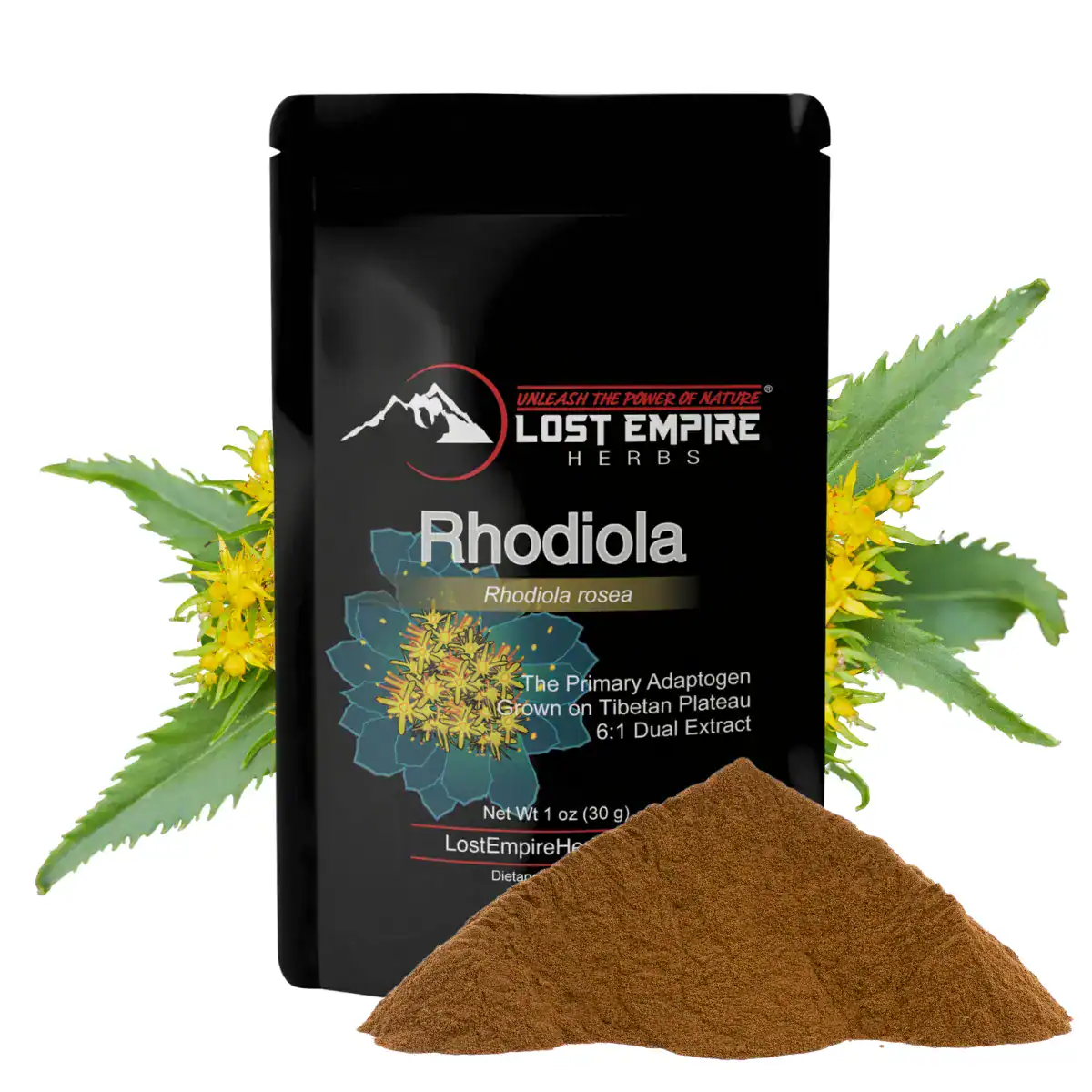
Example of a broader-spectrum Rhodiola approach focused more on long-term balance than aggressive stimulation.
Explore Lost Empire Herbs Organic 6:1 Dual ExtractFor people already dealing with chronic stress, cognitive fatigue, or nervous system overload, this type of smoother, full-spectrum approach often feels easier to sustain long term.
Rhodiola in Modern Nootropic Stacks
Rhodiola rosea is rarely used today as a standalone “energy herb.”
More often, it appears inside broader nootropic stacks focused on productivity, mental endurance, and stress resilience.
That role fits Rhodiola surprisingly well.
Rather than acting as a primary stimulant, Rhodiola is usually positioned as a balancing layer — helping smooth cognitive fatigue and support steadier performance under pressure.
This is also one reason Rhodiola has become one of the more interesting U-Curve nootropics.
At moderate doses, it may support focus, energy, and resilience. Push the stimulation too far, however, and the experience can become mentally uneven for some people — a pattern that also appears frequently in modern approaches to studying, learning, and cognitive performance.
Modern formulations increasingly account for this.
For example, Mind Lab Pro uses a relatively moderate Rhodiola dose alongside ingredients like Citicoline, Lion’s Mane, and L-Theanine — aiming for steadier cognitive support rather than maximum stimulation alone.
In many cases, the best nootropic stacks are not the most intense ones — but the ones people can actually sustain long term.
Best Rhodiola Supplements in 2026
The “best” Rhodiola rosea supplement often depends less on marketing claims — and more on the type of experience you’re looking for.
Some people prefer calmer, broader-spectrum herbal extracts focused on long-term stress resilience. Others want a cleaner, more activating nootropic-style formula for productivity and mental endurance.
Both approaches can work well when matched to the right nervous system and context.
Broader Full-Spectrum Herbal Approach
Lost Empire Herbs Organic 6:1 Dual Extract takes a broader-spectrum, dual-extracted approach that feels more rooted in traditional adaptogenic herbalism than aggressive stimulation.
For many people, this type of formula feels smoother, steadier, and easier to sustain long term.
Eastern European Adaptogenic Style
Cosmic Nootropic Rhodiola Rosea Golden Root Extract leans more toward the classic nootropic and performance-oriented tradition.
The formulation feels more direct and functional — particularly for people already familiar with Eastern European nootropic culture and adaptogenic extracts.
Neither philosophy is automatically better.
The best Rhodiola supplement is usually the one that supports steadier cognition and resilience without pushing your system beyond its optimal range.
Who Should Be Careful With Rhodiola?
Rhodiola rosea is generally well tolerated, but it isn’t ideal for every nervous system.
Some people — especially those already prone to anxiety or overstimulation — may find certain extracts too activating at higher doses.
Timing also matters.
Taking Rhodiola too late in the day can interfere with sleep for some users, particularly when using more stimulating standardized formulas.
And like many adaptogens, response tends to depend heavily on stress load, sleep quality, and baseline nervous system regulation.
More is not always better.
Starting with lower doses and observing how you feel over several days is usually the smartest approach.
Final Verdict
Rhodiola rosea works best when it supports resilience — not endless stimulation.
That distinction becomes increasingly important in a world already overloaded with caffeine, stress, fragmented attention, and “always on” productivity culture.
For many people, Rhodiola’s real value is not sharper intensity, but smoother cognitive endurance.
Less internal resistance. More sustainable energy.
And as with most adaptogens, quality matters enormously.
The best Rhodiola supplements are rarely the ones chasing maximum stimulation alone. More often, they’re the ones that support steadier focus, calmer energy, and long-term nervous system balance people can actually sustain.
Whether that comes through a broader-spectrum herbal extract or a more structured nootropic stack ultimately depends on the person using it — and the kind of cognitive support they actually need.

Rhodiola in a Modern Nootropic Stack
Mind Lab Pro uses Rhodiola as part of a broader nootropic stack focused on steadier cognitive endurance, stress resilience, and calmer long-term performance support.
Explore Our Mind Lab Pro ReviewFrequently Asked Questions
Is Rhodiola rosea stimulating?
It can be mildly stimulating for some people, especially at higher doses or in heavily standardized extracts. Most users describe Rhodiola as smoother and calmer than caffeine-heavy stimulants.
How long does Rhodiola take to work?
Some people notice effects within a few days, particularly around stress tolerance and mental fatigue. For others, the effects feel more gradual and cumulative over time.
Can Rhodiola help with stress?
Many of the most discussed Rhodiola rosea benefits are connected to stress resilience, mental endurance, and steadier cognitive energy under pressure.
What’s the difference between standardized and full-spectrum Rhodiola?
Standardized extracts focus on fixed levels of compounds like rosavins and salidroside. Full-spectrum approaches aim to preserve a broader range of the plant’s natural phytochemicals.
Can Rhodiola be combined with nootropics?
Yes. Rhodiola is commonly used inside modern nootropic stacks focused on productivity, cognitive endurance, and stress resilience.
References & Further Reading
- Panossian, A., Wikman, G. — Effects of Adaptogens on the Central Nervous System and Stress Protection. Pharmaceuticals.
- Shikov, A. N., Kosman, V. M., Flisyuk, E. V., et al. — Natural Deep Eutectic Solvents for the Extraction of Phenyletanes and Phenylpropanoids of Rhodiola rosea L. Molecules, 25(8), 1826.
- Cuerrier, A., Ampong-Nyarko, K. — Rhodiola rosea. In: Medicinal and Aromatic Plants of the World. CRC Press / Taylor & Francis.
- Spasov, A. A. et al. — A Double-Blind, Placebo-Controlled Pilot Study of Rhodiola rosea. Phytomedicine.
- Additional overview: Examine.com Rhodiola Rosea Research Overview
Relevant posts

Pure Shilajit Benefits | What It Does, How to Use It & Why Resin Matters

Lion’s Mane Mushroom | Unlock Brain Power, Boost Gut Health & Protect Neurons
