Real Trends, Data, and User Insights for the Year Ahead
The discussion around nootropic trends has shifted dramatically in recent years, and nowhere is that change more visible than in online communities.
- By Linda Niro — Nootropic Blend Guest Contributor
- Updated
- Affiliate disclosure
We prioritize readers, not ads. Editorial independence. Free, factual information. A small fee from product links, no extra cost to you.
A recurring sentiment on r/Nootropics in early 2025: users increasingly described moving away from the idea of a “magic pill” and toward managing everyday cognitive symptoms like afternoon brain fog, signaling a shift from peak performance chasing to baseline wellness maintenance.
A common theme across biohacking forums in late 2024: users described feeling that high-caffeine stacks were becoming outdated, with mushroom and peptide-based approaches gaining traction as the more forward-looking choice.
A growing sentiment across nootropic communities in early 2025: users reported that sustained, crash-free focus from compounds like Lion’s Mane or Selank outperformed high-caffeine stacks for long workdays, with the conversation shifting from intensity of focus to consistency throughout the day.
Reddit users who switched from high-dose stimulants to Rhodiola throughout 2024 commonly reported reduced anxiety and improved creative output, with many acknowledging that while they missed the immediate intensity, they did not miss the jitters or disrupted sleep that came with it.
A recurring pattern in student-focused nootropic discussions heading into late 2024: each exam season brought a fresh wave of posts asking which nootropics were safe to use, reflecting a broader shift in student culture toward cognitive wellness rather than simply enduring all-nighters.
TL;DR – Key Insights
- The nootropics market is shifting away from high-stimulant stacks toward sustainable cognitive wellness solutions.
- Natural compounds such as Lion’s Mane, Rhodiola, and Ashwagandha are gaining popularity due to their focus on long-term brain health.
- Peptide-based nootropics like Semax and Selank remain niche but are rapidly expanding within advanced biohacking communities.
- Growing ADHD diagnoses and medication shortages are driving interest in natural focus-support supplements.
- AI-driven supplement personalization and data tracking are emerging as the next major evolution in cognitive enhancement.
Table of Contents
Where the Market Stands in 2026

As of early 2026, the global nootropics market is estimated to be approaching
$5 to $7 billion in annual revenue, according to projections from Grand View Research and other leading market analysts and continues to accelerate toward a projected $11+ billion by 2030.
The landscape looks fundamentally different from even two years ago.
Stimulant-forward formulations have lost significant market share to adaptogenic and mushroom-based products. Peptide-based cognitive enhancers, once confined to niche biohacking communities, are entering mainstream awareness.
AI-driven personalization platforms now guide a growing share of consumer decisions, and third-party testing has shifted from a differentiator to a baseline expectation.
Three defining forces shape the 2026 market: a consumer base that prioritizes sustained cognitive wellness over acute performance spikes; regulatory momentum toward greater transparency and standardized labeling; and the continued integration of digital health tools that make personalized supplementation more accessible than ever.
The sections that follow trace how these shifts emerged and where they are heading.
Evolving User Conversations: The Data-Backed Foundation
These snippets, drawn from diverse online communities and digital watercoolers, capture the cognitive enhancement landscape as it stands in 2026: a movement that has decisively shifted away from chasing peak stimulation and toward sustainable performance.
Instead of searching for the mythical “Limitless pill,” users now seek real solutions to new-world distractions and fatigue.
This behavioral change is grounded in hard data—from market reports to Google Trends to research across age and occupational lines.
The conversations unfolding across forums and research communities offer a revealing look at how the future of nootropics is taking shape.
Trends from Google: How Search Behavior Has Shifted
Google Trends offers a window into the collective mind of the modern cognitive enhancement community.
Over the past three years, search volume for nootropics for memory retention and “focus supplements without caffeine” has grown substantially, outpacing more general searches like “best brain booster.”
Related queries—“how to alleviate brain fog,” “study nootropics for ADHD,” “safest supplements for long-term use”—continue to show significant increases in English-speaking regions heading into 2026.

The US, UK, Germany, and India have seen notable growth in focus-related queries.
Global online searches for ADHD surged by 270% between 2019 and 2023 across nearly every major English-speaking country studied (YouGov Signal, 2024), with the ongoing Adderall shortage driving a parallel spike in searches for natural focus supplements
that left 71.5% of adults reporting difficulty filling their prescriptions.
Spikes align with academic calendars and fiscal reporting periods, revealing how both students and professionals are relying on supplementation not for superhuman productivity, but as essential support during demanding cognitive seasons.
The Growing Nootropics Market: Size and Demographics
| Segment | Key Data | Context | Source |
|---|---|---|---|
| Global Nootropics Market | $3.75B (2022) → $11.17B projected by 2030 | Approx. 14.6% CAGR driven by cognitive wellness demand | Grand View Research |
| University Students | 5–35% report trying cognitive enhancers | Regular monthly use estimated around 2–5% | Multiple university studies |
| Brain Health Supplements | 23% of U.S. adults report using brain health supplements | Higher usage among knowledge workers | AARP / Ipsos Survey |
| ADHD Alternative Supplements | 26% of adults tried cognitive supplements | 61% reported at least some perceived benefit | ADDitude Magazine Survey |
| Adults 40+ | Fastest growing consumer segment | Focus on memory support and cognitive longevity | Industry market analysis |
The global nootropics market was estimated at $3.75 billion in 2022 and is projected to reach $11.17 billion by 2030, growing at a CAGR of 14.6%, according to Grand View Research (2023).
The Asia-Pacific region is expected to experience the fastest growth at 15.7% CAGR, driven by traditional medicine acceptance and expanding middle-class populations.
Yet these topline numbers conceal deeper demographic shifts in who is actually using nootropics—and why.
Among university students, usage varies significantly by region and program. Research indicates that between 5–35% of students in North America have tried cognitive enhancers, with regular monthly use ranging from 2–5%.
Medical and STEM students show higher usage rates.
A 2024 study at a Dutch university found 11.5% of students had used cognitive enhancers, while Portuguese universities reported rates as high as 32% among certain programs.
The most recent large-scale nationally representative dataset on this behavior—the AARP and Ipsos Brain Health and Dietary Supplements Survey (2019)—found that approximately 23% of U.S. adults were already taking at least one supplement specifically for brain health.
Consumer research and industry analysts consistently find this figure to be significantly higher among knowledge workers in high-pressure fields such as tech, finance, and healthcare, where cognitive performance is directly tied to professional outcomes.
Nootropic use among individuals 40+ is rising fastest. Market research indicates substantial growth in this segment since 2021, with “maintaining mental clarity” and “supporting healthy aging” most commonly cited as reasons for use.
Across aging and wellness communities on Reddit in early 2025, users increasingly described older family members adopting Lion’s Mane after reading about it in mainstream wellness publications.
In many cases the motivation was not biohacking culture, but a straightforward desire to stay mentally sharp and retain everyday details.
This demographic expansion—from students to aging professionals—helps explain why the nootropics market is increasingly framed not as a niche biohacking trend, but as part of the broader cognitive wellness movement.
The Decline of the Stimulant Era and Burnout Backlash
For years, vendors pushed formulations loaded with racetams, high-dose caffeine, and synthetic stimulants.
As recently as 2022, Reddit threads were filled with posts like: “What’s the safest way to use modafinil for 12-hour shifts?”
By 2026, the pendulum has clearly swung in the opposite direction.

In cross-platform Reddit polls and community discussions throughout 2024, a clear majority of users reported actively moving away from stimulants due to side effects—primarily anxiety, poor sleep, and eventual cognitive “crashes.”
Search volume for “side effects caffeine pills” and “can’t sleep after nootropics” has increased steadily since 2023.
Forum conversations increasingly emphasize balancing energy with well-being.
Posts on r/Nootropics throughout 2024 reflected a recurring pattern: users describing quitting high-stimulant stacks following anxiety episodes or panic attacks, and subsequently turning to the community for non-stimulant focus alternatives and recovery-oriented approaches.
This sentiment is now reflected clearly in market data.
Industry reports show continued declining sales of stimulant-based cognitive aids across several regions, while adaptogenic nootropics and “neurotrophic” products have picked up the slack and now represent the fastest-growing product segment.
Increasingly, users appear less interested in short bursts of stimulation and more focused on sustainable cognitive performance.
The Rise of Mushrooms, Adaptogens, and the "Baseline" nootropic Stack
The clearest winners of this paradigm shift are natural compounds—especially medicinal mushrooms (Lion’s Mane, Cordyceps), herbal adaptogens (Rhodiola, Ashwagandha), and “neuro-supportive” nutrients.
All of these categories now dominate the growth conversation heading into 2026.

Consumer Trends & Review Data
Amazon reviews for Lion’s Mane and other mushroom-based products increasingly emphasize “clarity without jitters,” “calm focus,” and “long-term benefits” over “instant boost” and “all-night energy.”
Supplement retailer data shows that repeat buyers of mushroom-based supplements most commonly cite improved day-to-day focus and memory as their primary reason for continued use.
Ashwagandha now generates 6.9 million monthly Google searches, up 32% year-over-year (Glimpse, 2025), while branded extract sales on Amazon grew 62% in 2024 (SPINS).
The majority of consumer interest is tied to mental clarity, stress relief, and focus without anxiety.
Lion’s Mane reviews on platforms like iHerb follow a consistent pattern as of late 2024: users report little noticeable effect in the first week.
After roughly a month of daily use, many describe subtle but meaningful improvements in sustained focus and the ability to complete work without mental fatigue setting in.
Clinical Research & Efficacy
Research on popular natural nootropics shows mixed but promising results.
- Lion’s Mane (Hericium erinaceus): Recent studies from 2023–2024 have shown mixed results. Some trials indicate improvements in cognitive function, working memory, and stress reduction, particularly after 4+ weeks of supplementation. However, a 2024 systematic review notes that current evidence is “limited” and effects are modest. More large-scale, long-duration studies are needed (Docherty et al., 2023; Cha et al., 2024).
- Rhodiola rosea: A 2024 review in Frontiers in Pharmacology found supplementation was associated with improvements in self-rated stress resilience and reported work performance among young professionals, though individual responses varied significantly.
- Ashwagandha: Multiple studies show consistent benefits for stress reduction and cortisol modulation. Some research suggests improvements in attention and mental clarity, though cognitive effects are generally more modest than stress-related benefits.
It’s important to note that while these compounds show promise, effects are typically subtle and cumulative rather than immediate.
Most natural nootropics demonstrate modest cognitive benefits compared to prescription medications, and individual responses vary considerably.
Rhodiola users on r/Productivity in December 2024 described it as a reliable, undramatic solution for afternoon energy dips, consistently characterizing the effect as not transformative but dependably useful at reducing end-of-day fatigue and supporting sustained output.
The Peptide Frontier: Niche, Rapidly Expanding, and Data-Driven
A parallel but distinct trend runs through the more advanced corners of the nootropics world: neuroactive peptides and peptide bioregulators.
In communities like r/Peptides, Discord servers, and Telegram groups, discussion around intranasal Semax and Selank, Dihexa, and Cerebrolysin has grown substantially.
Anecdotal reports from these communities suggest users prefer peptides for “clean,” sustained focus and emotional stability.
However, it’s crucial to note that peptide use remains highly experimental:
<ul style=”margin-left:20px;”> <li>Most cognitive peptides lack FDA approval and operate in regulatory gray areas</li> <li>Clinical research is limited, with most studies conducted outside the US</li> <li>Quality control and sourcing present significant safety concerns</li> <li>Long-term safety data is largely unavailable</li> </ul>
Students in peptide-focused online communities described using Semax during exam periods in late 2024, frequently citing its sharpness without the stimulant comedown as a key advantage, while also expressing frustration at its limited legal availability in the US.
Selank users on r/Peptides in late 2024 frequently described a dual benefit of reduced anxiety alongside improved conversational focus, consistently distinguishing its effects from caffeine as steadier and more level rather than stimulating.
A prevalent view in peptide-focused communities in early 2025: enthusiasts speculated that if compounds like Semax and Selank were available over the counter, mainstream adoption would accelerate rapidly, particularly among graduate students already experimenting with nootropics.
Beyond Focus: The Rise of Cognitive Wellness and Mental Resilience
Reddit’s r/Nootropics has seen a qualitative shift: threads about “ultimate study stacks” now compete with discussions on brain fog, burnout prevention, and mental health.
Users increasingly seek “all-day clarity” over bursts of restless energy.
Market surveys indicate that consumers want cognitive supplements for multiple, overlapping goals:
Sustained productivity throughout the day
Better memory retention
Emotional resilience and stress management
Sleep quality and recovery
Overlapping with broader wellness trends, the “neuro-support” conversation now includes sleep hygiene, diet, exercise, and deliberate tech breaks—recognizing that no supplement can compensate for poor fundamentals.
A recurring message across r/GetDisciplined and related productivity communities throughout 2024: no supplement stack can compensate for inadequate sleep and lack of exercise.
The prevailing community consensus positions healthy fundamentals as the real foundation, with compounds like Cordyceps or Bacopa as optional complements rather than substitutes.
Nootropics & ADHD: Bridging Prescription Gaps
ADHD diagnoses continue to climb, and widespread medication shortages have driven many to explore alternatives.
The Adderall shortage that began in late 2022 intensified throughout 2024, with 71.5% of adults with ADHD reporting difficulty filling prescriptions. This has coincided with increased interest in natural cognitive support.
Global online searches for ADHD surged by 270% between 2019 and 2023 across nearly every major English-speaking country studied (YouGov Signal, 2024).
At the same time, searches for over-the-counter focus support have increased in parallel, driven in part by ongoing medication shortages.
Reddit communities are rich with anecdotal exploration.
Discussions on r/ADHD throughout 2024 reflected a pattern of users supplementing their prescription medication with L-theanine and Lion’s Mane on off-days, citing a desire to manage the restless or “racy” feeling that stimulant medications can produce while maintaining a degree of daily cognitive support.
Survey data from ADDitude Magazine (2024) of adults managing ADHD found that approximately 26% had tried at least one “alternative” cognitive supplement in the past year.
Among those who experimented with alternatives, about 61% reported “some benefit,” particularly for memory and executive function.
However, effects were generally less pronounced than prescription medications and varied considerably between individuals.
The ADHD supplements market is projected to reach $0.97 billion by 2032, reflecting growing interest in complementary approaches.
It remains important to note that natural alternatives should not replace medical treatment without professional guidance.
As this segment matures, the emphasis in 2026 is increasingly on evidence-based stacking and individualized protocols rather than broad-spectrum substitution.
Professional Workplaces, Cognitive Aids, and Data Transparency
Among professionals, demand for cognitive aids is intertwined with the “always-on” nature of white-collar work.
Surveys of knowledge workers across the US, UK, and Germany suggest that a significant percentage have used or considered using cognitive supplements to meet job demands.
Many report first experimenting during remote or hybrid work phases that followed the pandemic.
The landscape is shifting toward greater transparency.
Consumer research indicates:
- Ingredient transparency has become a top concern for regular supplement buyers
- Products from trusted nootropic vendors often publish third-party lab testing and batch verification.
- Consumers increasingly research ingredients before purchase and seek scientific backing
Transparency has increasingly become a baseline expectation among regular supplement buyers.
A common refrain across r/Nootropics and r/Supplements in late 2024: users described refusing to purchase from brands that do not publish third-party lab results, citing past negative experiences with opaque proprietary blends.
Students: Coping with Cognitive Demands
Student demand for cognitive support peaks seasonally, mirroring academic calendars.
Google Trends and Reddit both show surges in “best nootropics for exams,” “memory support for finals,” and “healthy alternatives to Adderall” every April and December.

Research on student nootropic use reveals complex patterns:
Usage rates vary significantly by country, program, and academic pressure. Medical and STEM students report higher rates than liberal arts students.
In North America, 5–35% of students have tried cognitive enhancers, with regular monthly use around 2–5%.
European rates vary widely: Dutch studies show around 11.5% usage, while some Portuguese universities report up to 32% among certain programs.
Academic motivation and social pressure are primary drivers, along with increasing academic workloads.
University health centers report growing interest in workshops on safe, evidence-based nootropic use, and the risks of unregulated products.
The UK’s National Union of Students (2024) found that a substantial percentage of students use some form of cognitive support—legal, herbal, or supplement—during high-pressure periods.
Student-focused discussions on r/Nootropics heading into the December 2024 exam period reflected a clear preference for milder, non-stimulant options like Bacopa and ginseng.
Many users explicitly stated a desire to avoid supplements that cause an elevated heart rate or anxiety.
40+ Users: Focus Support for Midlife and Beyond
While Gen Z and Millennials dominate Reddit and Discord discourse, the fastest-growing segment in real-world sales is those aged 40 and above.
Increasing interest in “age-related memory support” is driving historic growth in omega-3s, B-vitamins, and nootropic mushrooms.

Market research indicates that a majority of new buyers of cognitive health products aged 40–59 cite “preventing brain fog at work” and “keeping sharp after hours” as primary motivations.
This population tends to prefer long-studied, transparently dosed products—especially those with dual claims such as “focus + healthy aging.”
In longevity and healthy aging communities on Reddit in late 2024, some users in the 40 and above demographic described adopting supplement routines alongside younger family members.
Their motivation was primarily cognitive clarity for professional and daily life, rather than performance optimization.
Tech Integrations: AI-Driven Supplement Stacks & Digital Self-Tracking
A major innovation shaping the modern nootropic landscape is the integration of digital health and AI.
Personalized supplement stacks—using app-driven tracking—are increasingly replacing one-size-fits-all approaches.
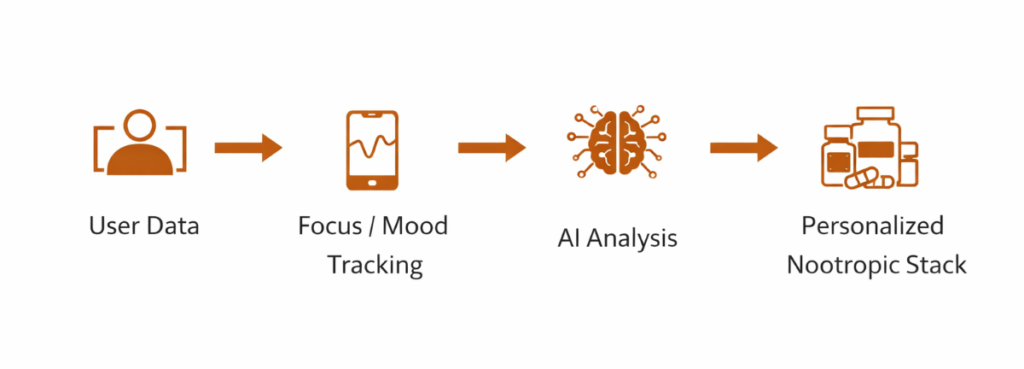
Apps like MindStack and Neuraform use data synthesis to build dynamic recommendations based on user tracking, reviews, and available research.
Market surveys suggest that a growing percentage of active supplement users have experimented with apps to track mental performance and adjust their routines accordingly.
On r/Biohackers in early 2025, users experimenting with AI-driven supplement apps described the personalization as surprisingly accurate.
Many reported that logging daily focus and mood data led to stack recommendations that meaningfully reduced the costly and time-consuming process of trial and error.
Safety, Sourcing & Regulatory Overview
Despite increased popularity, safety concerns persist and deserve serious attention:

A significant percentage of nootropic users report stopping at least one product due to side effects, primarily insomnia, cardiovascular effects, or digestive issues.
The FDA issued over 50 warning letters to nootropic companies between 2010–2019 for unverified health claims, contamination, or undisclosed ingredients.
Online searches for “is [nootropic] safe long term” have increased substantially from 2023 to 2024.
- Demand for third-party lab results and organic sourcing is at an all-time high, especially among consumers researching how to buy nootropics safely.
- Quality control varies dramatically between manufacturers, with some products containing significantly different doses than labeled or being contaminated with heavy metals.
Regulatory bodies (FDA, EFSA) continue working with industry stakeholders on standardizing labeling practices—an issue that echoes loudly through user-to-user forums.
Across nootropic review communities in early 2025, users consistently described third-party lab testing and batch-level traceability as non-negotiable purchase criteria.
Many cited past negative experiences as the reason for their heightened scrutiny of new products.
Important Limitations and Realistic Expectations
While the nootropics market continues growing, realistic expectations remain essential.
Most natural nootropics show modest effects compared to prescription medications. Effects are typically subtle and cumulative rather than dramatic.
Individual responses vary significantly. What works for one person may not work for another due to genetics, lifestyle, and other factors.
Many studies on popular nootropics are small-scale and short-duration, often producing mixed results. More research is needed.
No supplement can compensate for poor sleep, inadequate nutrition, lack of exercise, or chronic stress. Fundamentals matter most.
Caffeine (often combined with L-theanine) remains by far the most commonly used and well-researched cognitive enhancer, despite the growth of exotic alternatives.
Recent Research Highlights (2022–2025)

Several peer-reviewed analyses from 2022 through 2025 reinforce the trends discussed above.
A 2022 systematic review found that DHA supplementation was associated with modest improvements in cognitive processing among adults with an average age of 45.
A large-scale 2023 review indicated that ginkgo biloba supplementation may help attenuate age-related cognitive decline and support vocabulary retention.
In 2024, a research analysis highlighted creatine’s role in improving short-term memory and brain processing speed—notable because creatine is widely available through dietary sources such as meat, eggs, and fish.
Moving into 2025, research published in Brain Sciences demonstrated that multi-target nootropic formulations may support several domains of cognitive function simultaneously in placebo-controlled settings.
A separate 2025 study on citicoline (Cognizin®) reported improvements in mental energy, focus, and memory, attributed to enhanced cerebral metabolism.
While individually modest, these findings collectively point toward a maturing evidence base that increasingly supports the category’s core claims.
2026 Nootropic Categories Overview
The modern nootropics landscape is increasingly defined by several distinct categories.
The table below summarizes the major segments shaping the market in 2026, along with their typical compounds and current level of scientific support.
| Category | 2026 Direction | Key Examples | Evidence Level |
|---|---|---|---|
| Stimulants | Declining consumer preference, shift toward lower-dose, stacked approaches | Caffeine + L-theanine, low-dose modafinil | Strong (caffeine); moderate (modafinil off-label) |
| Adaptogens | Strong growth; now mainstream for stress-focus balance | Lion’s Mane, Rhodiola, Ashwagandha, Cordyceps | Moderate; growing but still mixed results |
| Peptides | Rapid niche expansion; entering mainstream awareness | Semax, Selank, Dihexa, Cerebrolysin | Limited; mostly preclinical or non-US trials |
| Baseline Stacks | Steady foundation; increasingly paired with AI-driven personalization | Omega-3s, B-vitamins, creatine, magnesium | Strong; well-established for foundational support |
The Verdict: Toward Informed, Balanced, and Personalized Enhancement in 2026
The dominant storyline heading into 2026 is not about chasing an elusive magic pill.
Instead, the data and dialogues point to a maturing market, a more knowledgeable user base, and a decisive bias toward sustainable, research-backed enhancement.
Instant fixes are out.
Subtle, long-term gains—supported by transparency, science, and self-tracking—are in.
Cultural dialogue has shifted.
Nootropics are no longer just a fringe curiosity or a student crutch—they are an evolving cornerstone of personal health stacks, pushed forward by users who now demand research citations, ingredient provenance, and honest reporting of both benefit and risk.
With AI giving users better tools for curation and self-quantification, and with growing awareness of both possibilities and limitations, the next phase of nootropic use is likely to be led by the most discerning—and most skeptical—generation in history.
The key is approaching cognitive enhancement with eyes wide open: understanding that benefits are often modest, that research is still evolving, that safety must come first, and that no supplement can replace the fundamentals of sleep, exercise, nutrition, and stress management.
For those who take this balanced approach, nootropics can be valuable tools in a comprehensive strategy for cognitive wellness—but they are tools, not miracles.
References & Sources
Market Research
- Grand View Research. (2023). Nootropics Market Size, Share & Trends Analysis Report.
- Allied Market Research. (2023). ADHD Supplements Market Analysis.
Clinical Research
- Docherty, S., et al. (2023). The acute and chronic effects of Lion's Mane mushroom supplementation on cognitive function, stress and mood in young adults. Nutrients.
- Cha, H. J., et al. (2024). Effect of Hericium erinaceus on cognitive function: A systematic review. Journal of Medicinal Food.
- Rhodiola rosea review on stress resilience. Frontiers in Pharmacology (2024).
Consumer Data
- YouGov Signal (2024) – Global search volume for ADHD skyrockets since 2019
- Glimpse (2025) – Ashwagandha trend data
- SPINS via Vitafoods Insights (2024) – Ashwagandha from Ayurvedic medicine to mainstream
- AARP & Ipsos (2019) – Brain Health and Dietary Supplements Survey
- ADDitude Magazine (2024). Reader Survey on ADHD Management.
Student Studies
- Various peer-reviewed studies on student cognitive enhancer use in North America and Europe (Netherlands, Portugal, UK).
Community Sources
- Reddit communities: r/Nootropics, r/ADHD, r/StudentNootropics, r/Biohackers, r/Productivity, r/GetDisciplined, r/AgingWell
- Discord nootropics communities
- iHerb user reviews
Regulatory Sources
- FDA Warning Letters Database (2010–2019)
- EFSA (European Food Safety Authority) Guidelines

Linda Niro
Linda Niro is a health and wellness writer focused on healthcare, nutrition, and preventive health. Her work helps make evidence-based wellness topics easier to understand for everyday readers.
More from Linda on Fitimins →Relevant posts

SaunaSpace Review 2026 | Real Near-Infrared Heat for Recovery & Longevity

Pine Pollen Tincture Benefits | Natural Testosterone & Vitality Booster
